Bad Blintz
The Amazing Maurice and His Educated RodentsBad Blintz is a town pressed against cliffs above a river valley, and the principal human setting for the struggle between its inhabitants and the intelligent rats. Its sparse market, blunt anti-rat notices, and public rat procession give the conflict a visible civic scale; its eventual agreement with the rats offers a beginning, rather than an effortless resolution, to that hostility.
Setting and first impressions
The town comes into view at dawn, after Maurice and the rats have crossed a forest pass in a highwayman’s saddle-bags. Its position is sharply defined: the valley stretches below, with Bad Blintz hunched against the cliffs. The name initially sounds ominous to Peaches, but Maurice explains that it means bath in the local language. That small misunderstanding establishes the gap between an outsider’s impression and the practical realities of the place.
When Maurice and the stupid-looking kid enter, the town is waking. It appears to be market day, but there are few stalls, and their wares—old pans and pots, used shoes, and other second-hand goods—suggest that many residents have little money. Maurice has seen markets elsewhere and recognizes that this one is not thriving. The town’s buildings, by contrast, are carefully carved and painted. Their workmanship stands against the roughness of the public notice nearby, which offers fifty pence for every rat tail and directs applicants to the Guild of Rat-catchers. The contrast puts craft and deprivation alongside an official campaign that treats rats as targets for a bounty.
The rat campaign and civic distrust
The notice makes the conflict part of ordinary public life: rat-catching is advertised as paid work, not presented as a hidden or private undertaking. Later, Malicia proposes taking evidence to the council so that the rat-catchers can be exposed, while speculating that the council and the Watch might be allied with them. Her suspicion is a possibility she raises, not a confirmed account of the town’s institutions. It nevertheless shows how difficult it is for the human characters to know whom they can trust while investigating the rat-catchers.
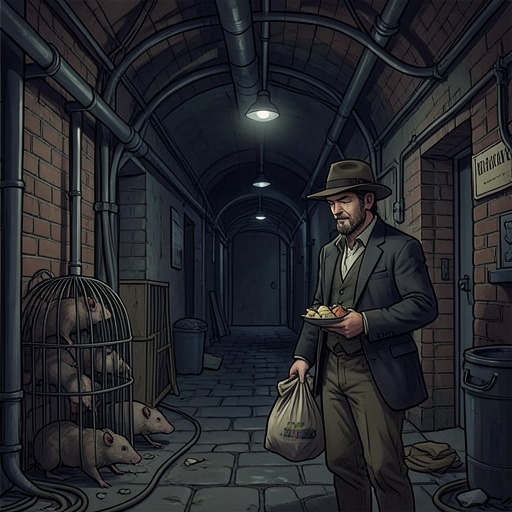
Bad Blintz is also a place in which the rats’ movements cross the boundaries of its human streets. Sardines races over drainpipes, roofs, and gutters, and younger rats join Darktan’s company as it moves through town. Some have fled in terror but not gone far; they fall in behind Darktan, seemingly relieved to have a purposeful task. Later, after Hamnpork is brought back from the stables, the group moves slowly along gutters and drains, relying on the cover of night. These routes make the town more than a human marketplace: its roofs, drains, and cellars form a parallel passage through which the rats gather, hide, and return.
Public spectacle and what it conceals
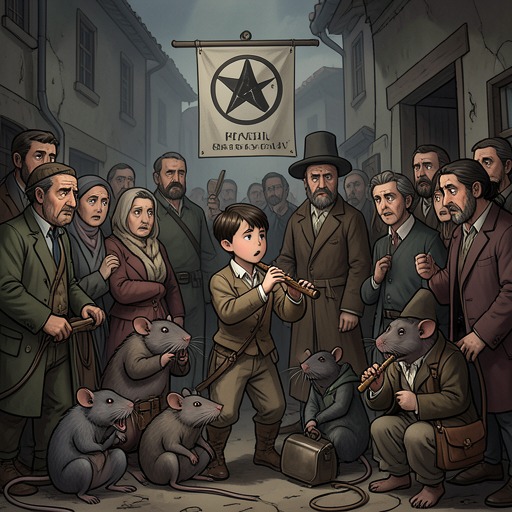
The rats’ departure becomes a public performance. After several days, people are glad to see the stupid-looking kid and his pipe, and they watch rats pour from holes to follow him out of town. The crowd is impressed, although the number of rats is only a few hundred. It cheers as the pipers leave with the rats and whistles when the animals plunge from the bridge into the river. The appearance of a mass departure is not the whole event: some rats remain on the bridge, urging the others onward and offering practical directions. The crowd does not notice them, and the narration pointedly observes that such details do not fit the story the onlookers think they have seen.
The actual destination of the rats and pipers is concealed from the public as well. Once they are out of town, they meet Maurice in the bushes and count out the money. The cheerful spectacle and the secret accounting belong to different versions of the same event: to the residents, a magical pipe has led the rats away; behind that public explanation lies a carefully arranged deception. Bad Blintz repeatedly makes appearances and hidden operations coexist, so that what the crowd accepts cannot be taken as a complete account.
From hostility to an uncertain accord
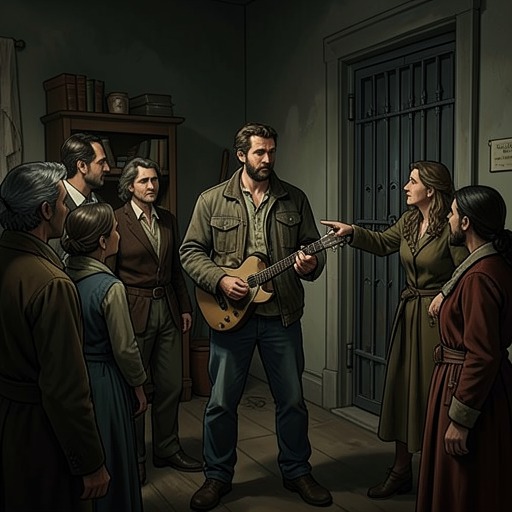
The town’s final significance lies in the attempt to replace the rat campaign with negotiation. In speaking with the mayor, Darktan says the arrangement might work precisely because people and rats are arguing. He gives it concrete reciprocal terms: the humans will not poison the rats’ cheese, and the rats will not urinate in the humans’ jam. He also acknowledges that the agreement will not be easy, but treats it as a start.
That exchange changes the terms on which Bad Blintz can imagine living with the rats. The bounty notice had reduced them to tails worth money; the agreement recognizes both groups as parties capable of making and breaking arrangements. The town is not shown as suddenly free of conflict. Rather, its movement is from a public policy of hostility and a secretive struggle toward an imperfect, practical coexistence whose success remains to be worked out.